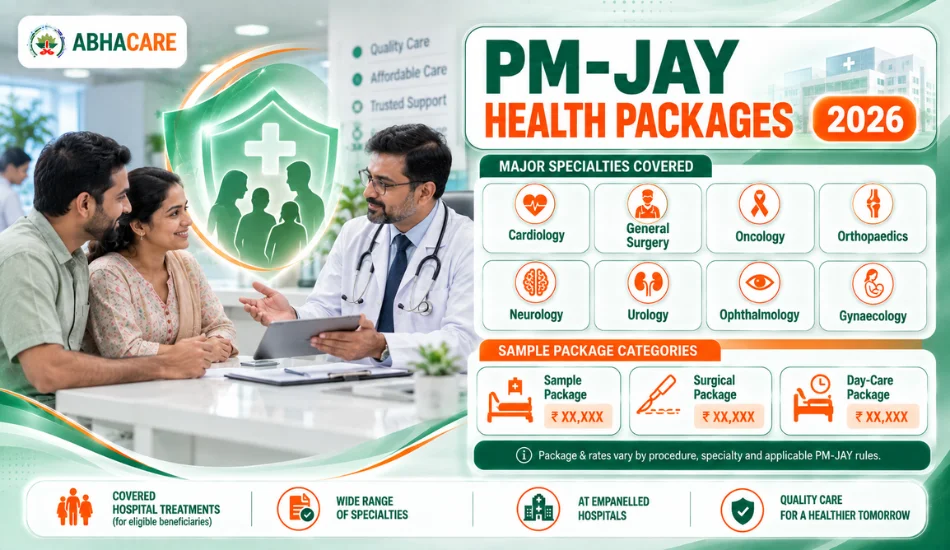
Ayushman Bharat PM-JAY provides cashless health coverage of ₹5 lakh per family per year nationally, rising to ₹10 lakh per family per year in Delhi due to an additional ₹5 lakh state top-up. As of the latest national Health Benefit Package (HBP) master, the scheme covers 1,961 procedures across 27 medical specialties, including cardiology, orthopedics, oncology, general surgery, and obstetrics. Senior citizens aged 70 and above are covered irrespective of income under the Ayushman Vay Vandana Card. Package rates are all-inclusive, covering surgery, ICU care, diagnostics, and medicines for the full episode of treatment at empanelled hospitals.
What Is Ayushman Bharat PM-JAY?
Ayushman Bharat Pradhan Mantri Jan Arogya Yojana (AB PM-JAY) is the Government of India's flagship public health insurance scheme, launched in September 2018 to provide free, cashless hospitalization coverage to low-income and vulnerable families. It's one of the largest government-funded health assurance schemes in the world by beneficiary count.
Key features:
- ₹5 lakh cover per family per year nationally for secondary and tertiary care hospitalization
- No restriction on family size, age, or gender
- All pre-existing medical conditions covered from day one, with no waiting period
- Covers pre-hospitalization (3 days) and post-hospitalization (15 days) expenses, including diagnostics
- Cashless and paperless treatment at empanelled public and private hospitals
- Eligibility based on the Socio Economic and Caste Census (SECC) 2011 deprivation and occupational criteria, covering roughly the bottom 40% of the population
PM-JAY in Delhi: ₹10 Lakh Cover
Delhi formally joined PM-JAY through a Centre–Delhi Government MoU, and the coverage in Delhi works differently from most states:
- ₹5 lakh from the central PM-JAY scheme
- + ₹5 lakh top-up funded by the Delhi Government
- = ₹10 lakh total cover per eligible family per year
As of the latest available figures, Delhi's empanelled hospital network includes approximately 233 hospitals (around 181 private and 52 government facilities), and coverage is portable — a Delhi cardholder can receive cashless treatment at any empanelled hospital anywhere in India, not just within Delhi.
Delhi's pre-existing Delhi Arogya Kosh (DAK) scheme continues to operate alongside PM-JAY, though recent guideline updates require verification that a patient isn't already covered under another scheme (PM-JAY, CGHS, or DGEHS) to prevent duplicate benefit claims.
Senior Citizen Coverage: Ayushman Vay Vandana Card
Since October 2024, PM-JAY has been expanded to cover all senior citizens aged 70 and above with ₹5 lakh per family per year in free treatment — regardless of income or existing socio-economic eligibility criteria. This coverage is issued through a distinct Ayushman Vay Vandana Card, separate from the standard PM-JAY card, and has been adopted by a large and growing number of senior citizens nationally since launch.
Major Specialties Covered Under PM-JAY
According to the latest national Health Benefit Package (HBP) master, PM-JAY covers approximately 1,961 procedures across 27 medical specialties. Major specialty categories include:
- General Medicine
- General Surgery
- Cardiology and Cardiothoracic & Vascular Surgery
- Orthopedics (joint replacement, fracture care, trauma)
- Oncology — both medical and surgical (Medical Oncology, Surgical Oncology, Radiation Oncology)
- Nephrology and Urology (dialysis, kidney stone treatment, kidney transplant)
- Neurosurgery
- Gastroenterology
- Obstetrics and Gynaecology (normal and caesarean delivery)
- Pediatrics
- ENT (Ear, Nose, Throat)
- Ophthalmology
- Burns Management
- Emergency Room Packages
- Critical/ICU Care
General Medicine and General Surgery have historically accounted for the largest share of claims by volume, though tertiary specialties like cardiology and oncology represent a significant share of overall claim value given their higher package rates.
Sample Package Rates (Illustrative)
⚠️ Important: these are illustrative figures reported by third-party industry sources, not confirmed directly against the official NHA package master at the time of writing. Verify every figure against the current official Health Benefit Package before publishing — see the compliance note below.
| Specialty / Procedure | Approx. Package Rate (₹) |
|---|---|
| Cataract Surgery | ~6,500 |
| Knee Replacement (unilateral) | ~80,000 |
| Cardiology (select procedures) | ~1,32,000 |
| Hernia Repair (general surgery) | Varies by package code |
| Normal Delivery | Lower-tier package |
| Caesarean Delivery | Mid-tier package |
Package rates are all-inclusive — they cover the entire episode of care (surgery, ICU stay where applicable, diagnostics, medicines) rather than being billed item-by-item. This structure is designed to prevent surprise or duplicate billing at empanelled hospitals, though it also means the "package rate" isn't directly comparable to a private hospital's itemized quote for the same procedure.
How PM-JAY Package Rates Work
Understanding the package structure matters for both patients and hospital billing teams:
- Each covered procedure has a specific package code and rate, revised periodically by the National Health Authority (NHA)
- Rates are all-inclusive of the full treatment episode — not just the surgery itself
- For procedures without a listed package, hospitals may use an "unspecified package" code under defined criteria, subject to pre-authorization
- Package rates are periodically revised — past revisions have included rate increases, new package additions, and in some cases, rate reductions or package discontinuations, based on NHA review
Who Is Eligible for PM-JAY?
Eligibility is primarily determined by:
- SECC 2011 deprivation and occupational criteria — covering roughly the bottom 40% of India's population by socio-economic status
- Senior citizens aged 70+ — eligible under the Ayushman Vay Vandana Card regardless of income, as a separate coverage category
You can verify your specific eligibility through the official PM-JAY portal or by visiting an empanelled hospital's Ayushman Bharat help desk, which can check eligibility using your Aadhaar or ration card details. Check your Ayushman Bharat eligibility with AbhaCare's support team before planning your hospital visit.
How to Access PM-JAY Treatment at AbhaCare Partner Hospitals
- Confirm your eligibility and card status before hospitalization where possible
- Visit the Ayushman Bharat help desk at an empanelled partner hospital
- Share your Aadhaar and relevant identification documents for verification
- The hospital handles pre-authorization directly with the scheme — treatment is cashless for covered procedures
- AbhaCare's support team can help you check empanelment status and guide you through the verification process before admission
Frequently Asked Questions (FAQs)
How much does Ayushman Bharat PM-JAY cover?
▼₹5 lakh per family per year nationally. In Delhi specifically, this rises to ₹10 lakh per family per year due to an additional state government top-up.
How many procedures does PM-JAY cover?
▼As of the latest national Health Benefit Package, approximately 1,961 procedures across 27 medical specialties, including cardiology, orthopedics, oncology, general surgery, and more.
Are senior citizens covered under PM-JAY?
▼Yes — since October 2024, all citizens aged 70 and above are covered for ₹5 lakh per family per year under the Ayushman Vay Vandana Card, regardless of income.
Is treatment really cashless under PM-JAY?
▼Yes, at empanelled hospitals, for procedures covered under the scheme's package list — patients aren't expected to pay out of pocket for covered treatment, though pre-authorization is required for most procedures.
Can I use PM-JAY at a private hospital?
▼Yes, provided the hospital is empanelled under PM-JAY. A significant share of PM-JAY treatments nationally are delivered through private hospitals.
Do PM-JAY package rates match private hospital pricing?
▼Not necessarily — PM-JAY package rates are government-negotiated, all-inclusive rates that can differ significantly from a private hospital's standard itemized pricing for the same procedure. This is one reason package rates have periodically been revised following feedback from hospital networks.