Is Piles Covered Under Health Insurance? Waiting Period, Laser Cover & How to Claim
Yes, in most cases. Piles (haemorrhoid) surgery, including laser treatment, is usually covered by Indian health insurance when it is medically necessary and done as a day-care procedure or hospital stay. The catch is the waiting period: most individual policies do not pay for piles for the first 1–3 years. Group or employer policies often have no waiting period for it. Treatment done only for cosmetic reasons, and claims where piles were not disclosed at purchase, are the usual reasons for rejection. Check your own policy wording before you book surgery.
Piles are common, and many people delay treatment because they are unsure about cost and cover. This guide explains what insurers usually pay for, how waiting periods work, and the exact steps to claim, so you can plan before you walk into a hospital.
Does Health Insurance Cover Piles Surgery?
Most comprehensive health policies cover treatment for piles when a doctor says it is needed. Typically covered:
- Surgery and laser treatment. Piles procedures do not usually need a long stay, so they are generally claimed as day-care procedures, provided your policy includes day-care cover.
- Hospital and doctor charges, including the surgeon's fee, anaesthesia and operation theatre.
- Pre- and post-hospitalisation costs: consultations, tests and medicines. Many plans allow roughly 30 days before and 60 days after, but this differs by policy.
Typically not covered or limited:
- Treatment done for cosmetic reasons only
- Experimental or unapproved treatments
- Amounts above a sub-limit or room-rent cap
- The co-payment share, if your policy has one
- Claims during the waiting period
Cover is decided by your policy wording, not by the name of the procedure. Two people with piles surgery at the same hospital can get different outcomes under different policies.
Waiting Period for Piles in Health Insurance
This is the part that decides most claims. There are two different waiting periods, and people often mix them up:
| Type | What it means | Typical length |
|---|---|---|
| Specific disease waiting period | Piles is on the insurer's list of conditions not covered for the first years of the policy | Commonly 1–2 years, depending on policy |
| Pre-existing disease (PED) waiting period | Applies if you were diagnosed or treated for piles before buying the policy | Up to 3 years under current IRDAI rules; some policies shorter |
| Initial waiting period | Non-emergency, non-accident claims are excluded at the start | Usually 30 days |
Under IRDAI's 2024 rules, which apply to policies starting on or after 1 October 2024, the maximum waiting period for pre-existing conditions is capped at 36 months of continuous cover. Older policies may carry longer terms, so check yours. Waiting periods are counted from the policy start date, and they carry over when you port a policy or renew without a break.
Group and corporate policies usually have no waiting period for piles, which is why employees often get claims approved that an individual buyer could not.
Is Piles a Pre-Existing Disease?
It becomes one if you had symptoms, a diagnosis or treatment before buying the policy. Insurers may then add a waiting period, charge a higher premium or exclude it. Two practical points:
- Disclose it in the proposal form. Not mentioning a known condition is a common reason for claim rejection, even after the waiting period is over.
- A first-ever diagnosis after you buy the policy is treated differently from a known condition, but the specific-disease waiting period can still apply.
Is Piles Laser Treatment Covered?
Often yes. Laser treatment for piles is generally covered when it is medically advised and your policy includes day-care procedures. What to confirm:
- Is the procedure listed in your policy's day-care list?
- Does the policy have a sub-limit for piles or for this procedure type?
- Does the hospital's package price include laser consumables, anaesthesia and follow-up?
Laser is not always the better option. The right procedure depends on the grade of your piles, which a surgeon decides after examination. Insurers cover what is medically necessary, not what is most expensive.
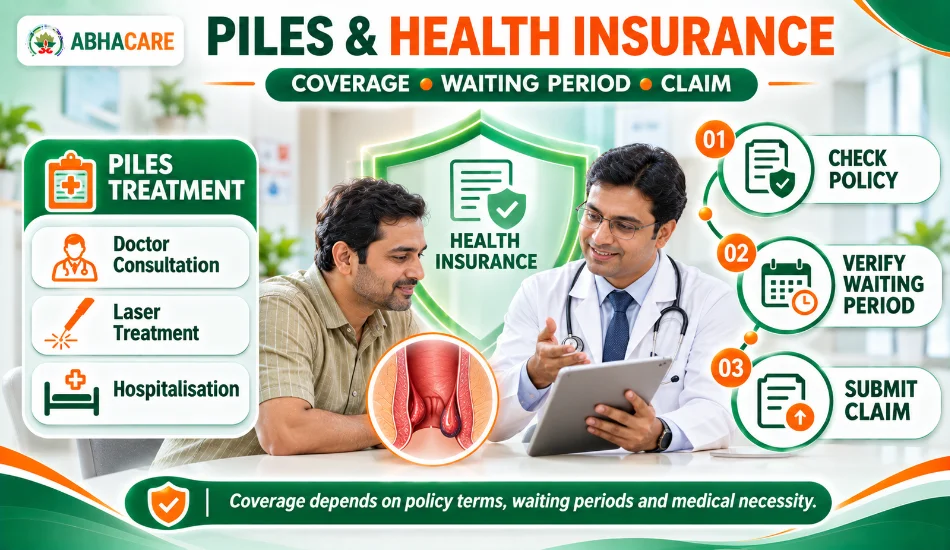
Cashless vs Reimbursement: How the Claim Works
Cashless (network hospital)
- Choose a hospital on your insurer's network.
- Show your health card or policy number at the hospital's insurance desk.
- The hospital sends a pre-authorisation request with the doctor's advice and tests.
- For planned surgery, request it before admission and allow a few days. Emergency approvals are faster.
- The insurer pays the hospital directly. You pay only non-covered items and any co-payment.
Reimbursement (any hospital)
- Pay the bill yourself and keep every original document.
- Submit the claim to the insurer within the time limit in your policy.
- The insurer checks the file and pays the admissible amount, which can be lower than what you paid.
Documents to keep
- Doctor's prescription and diagnosis or advice for surgery
- Test and scan reports
- Hospital bills with itemised charges and receipts
- Discharge summary
- Policy copy, ID proof and the claim form
- Cancelled cheque or bank details (for reimbursement)
Why Piles Claims Get Rejected
- Treatment started inside the waiting period
- Piles not disclosed when the policy was bought
- Procedure judged cosmetic or not medically necessary
- Documents missing or bills not itemised
- Treatment at a non-network hospital without informing the insurer first
- Claim filed after the policy's deadline
If a claim is rejected, ask for the rejection reason in writing, check it against your policy wording, and appeal to the insurer's grievance team. If unresolved, you can escalate through the IRDAI's Bima Bharosa grievance portal or the insurance ombudsman.
Piles Surgery Cost in Delhi and Why It Matters for Your Claim
Published guides put piles surgery at about ₹20,000–₹50,000 for open surgery and about ₹40,000–₹80,000 for laser treatment, depending on the hospital, grade of piles and room type. These are indicative published figures, not quotes. Prices last checked on [date]; replace with your partner hospitals' real prices.
Ask for an itemised estimate before surgery. Your insurer will compare it against its allowed limits, and a clear estimate reduces surprise deductions later.
What to Check Before You Book Surgery
- Your policy start date and how many months of waiting are left
- Whether piles is in the specific-disease waiting list
- Whether day-care procedures are covered
- Any sub-limit, room-rent cap or co-payment
- That the hospital is on your insurer's cashless network
- Pre-authorisation approved in writing before admission
Other Anorectal Conditions
Piles, anal fissure, anal fistula and pilonidal sinus are often grouped together by insurers, and they usually face similar waiting periods. See our guides on anal fissure treatment and anal fistula treatment.
When to See a Doctor
See a doctor if you have rectal bleeding, pain, a lump that does not go back in, or symptoms lasting more than a couple of weeks. Do not assume bleeding is piles. Rectal bleeding can also be caused by other conditions that need testing. Go to an emergency department for heavy bleeding, severe pain with fever, or dizziness.
How AbhaCare Helps
- Reads your policy with you and flags waiting periods, sub-limits and exclusions
- Matches you with a surgeon for a proper diagnosis
- Gets itemised estimates from partner hospitals
- Helps with pre-authorisation paperwork and claim documents
[Add AbhaCare's address, phone, hours, map and Google Business Profile link.]
Frequently Asked Questions (FAQs)
Is piles covered under health insurance?
▼Usually yes, when surgery is medically necessary, but most individual policies apply a waiting period of 1–3 years first.
Is piles laser surgery covered?
▼Often, as a day-care procedure, if your policy includes day-care cover. Check for sub-limits.
What is the waiting period for piles in health insurance?
▼Commonly 1–2 years as a specific-disease waiting period, and up to 3 years if it is a pre-existing condition under current IRDAI rules. Group policies often have none.
Can I claim piles surgery from day one?
▼Generally no on an individual policy. Group or employer cover may allow it, and accidents and emergencies are treated differently.
Does health insurance cover piles surgery cost in Delhi?
▼Yes, subject to your policy terms. Cashless is available at network hospitals, and reimbursement works at any hospital.
What if I did not mention piles when buying the policy?
▼The claim can be rejected, even after the waiting period. Always disclose known conditions.
Does Ayushman Bharat cover piles surgery?
▼[Verify before publishing: check the current PM-JAY package list or ask an empanelled hospital's Ayushman desk. Do not state cover unless confirmed.]
Can I port my policy to avoid the waiting period?
▼Porting carries over the waiting period you have already served. It does not reset it, but it cannot remove a waiting period that is still due.
Book a Consultation
Get a diagnosis, an itemised estimate and help with your insurance paperwork.
✔ Surgeon consultation ✔ Policy and waiting-period check ✔ Cashless pre-authorisation help ✔ Itemised cost estimate